
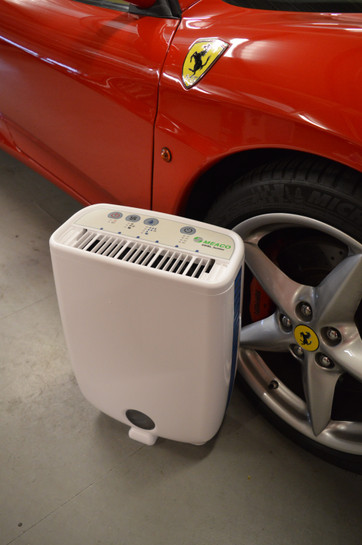
If you want a dehumidifier for your garage then you are probably storing something important that needs to be protected.
The top 4 problems
- Anything paper based will most likely suffer from excess humidity in a garage and will shows signs of mould and dimensional change.
- Anything made from metal will rust. This includes your Ferrari.
- Classic and modern cars and bikes are made from a mix of materials that are vulnerable to damp – leather, metal, wood veneer and cloth for example.
- Other likely items to need protection in a garage would include tents, wine, biking gear, photos, old records and furniture.
Why do we get these damp problems in our garages?
- Paper is organic and therefore wants to be in equilibrium with its surroundings. If the air is damper than the paper then the paper will absorb the moisture which will make the paper grow in size and will encourage mould growth on the paper.
- The surface of metals will be cooler than the air around it, this means that condensation is more likely on metal items. When water forms on metal then the iron or steel reacts with the water and oxygen, and rust forms.
- Leather, wood veneer and cloth react to moisture in a similar way to paper in that they like to have the same level of humidity as their surroundings. As they become damp they will peel and allow mould and fungus to grow.
And of course we live in a damp part of the world.
Is this damaging for our wealth?
Cleaning, maintaining and in the worst case replacing the items that you are storing in the garage can be costly. In the case of family heirlooms these items cannot be replaced and have to be preserved. Classic cars and bikes are expensive enough to maintain and with these things prevention is better than cure. Brake discs for example seem especially prone to rust on certain models like the 360/430.
So what is the solution?
Increased ventilation is not really a solution for a garage as you cannot leave windows open without a security risk and you are not going to run out to the garage every time it rains to close it. You also have no way of knowing if the air coming into the garage is damper or drier than the air that is already in there.
The solution is to have a well-sealed garage coupled with a dehumidifier to keep the air dry.
Why will a dehumidifier protect my belongings in the garage?
- A dehumidifier removes the excess moisture from the air which reduces the relative humidity. If the relative humidity is lower then mould will not form on the paper based material in the garage.
- A lower relative humidity will mean that condensation should not form on the metal of tools and car/bike parts.
- Your cars will benefit from the lower humidity in that the mould and fungus will not form on the cloth and leather. You need a dehumidifier with a humidistat so that you do not over dry the air which could crack the leather, rubbers and veneer.
- The other organic material in the garage will benefit from the lower relative humidity and will now be in the ‘safe zone’ for storage.
Where do I put the dehumidifier?
Somewhere close to a power supply so that you do not have to use an extension lead. As you are unlikely to be in the garage that often then using a hose for continuous drainage is sensible so that the dehumidifier does not turn off when the bucket is full waiting for you to empty it. Make sure that the dehumidifier and those things that you are protecting benefit from good air circulation within the garage.
Seal the garage up so that you have as few air changes with outside as possible.
Which dehumidifier should I buy?
There are two types: desiccant and compressor dehumidifiers. A desiccant dehumidifier does not have a compressor, refrigerant or cooling coils which makes it lighter, quieter and kinder on the environment when it has to be recycled at the end of its lifespan. As temperatures fall, compressor dehumidifiers extract less water and cost more money per litre of water extracted, whereas desiccant dehumidifiers are pretty much consistent and their performance does not change much as temperatures change. A good rule of thumb is to use compressor dehumidifiers above 16°C and desiccant dehumidifiers below this point. A desiccant dehumidifier has a higher wattage than a compressor dehumidifier because it has an internal heater, but it will put heat back into a room: good for the winter months. This internal heater will also prevent it from icing up because the internals will always be significantly warmer than the room it is standing in: important for spaces such as garages.
The Meaco DD8L is the obvious choice in Northern Europe because it’s performance is consistent at low temperatures (your garage will be unheated in winter), it has a good humidistat, can be drained continuously, has Auto Restart so it will turn back on after a power cut and has a host of safety features to make sure that it is safe to be left alone. It also won Best on Test when Sailing Today magazine looked at dehumidifiers for unattended application. It’s been well proven over several years amongst dozens of car owners, including myself.