
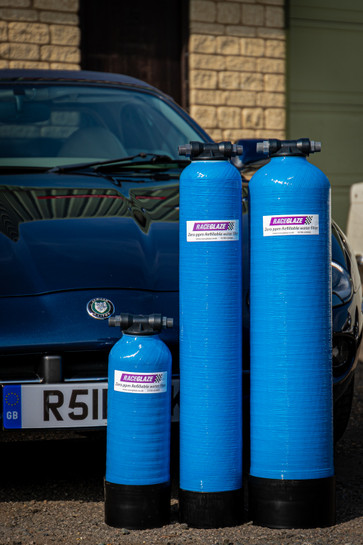
Which size 0ppm car washing water filter is best for me ?
Two quick bits of intro advice - use a new hose, as old one will have limescale on inside which will get washed off onto your car. And use for final rinse only.
Which size you need depends on how often you wash the cars and how quick you are – a typical saloon should take 40 seconds, a small SUV like a BMW X3 about 60. Then how hard is your water ?
I certainly wouldn’t want to be lugging a 25L filter about, so I suggest your choice is between 7 and 14L units (the sizes we sell) and 11L units sold by others. I'd therefore recommend you read this about aspect ratio which determines economy. Feel free to send us your water hardness (from your water company website, in ppm, and we'll tell you what each of our filters will produce).
The size and shape of the unit has a big impact on the maximum flow rate of the water through the unit, the volume of water that can be treated before the resin needs changing and also the quality of the water produced. The performance of a water filter comes down to contact time between the water and the mixed bed resin within the unit. The longer the contact time, the better the quality of the water will be, as the resin has longer to remove the dissolved ions (or impurities).
The best way to achieve long contact time is to have a good amount of resin in relation to the flow rate of the water. This is represented by what is known as the 40 bed volumes per hour rule. That is the bed volume of resin in the unit multiplied by 40 which gives the optimum flow rate of water for that sized unit per hour. So a unit with 6 litres of resin in should (theoretically) be able to treat up to 240Lts per hour. In real terms this rule is rarely adhered to however, but does give a good guideline to the effectiveness if individual units.
Unfortunately the story doesn’t end there as the aspect ratio of the filter also needs to be taken into account. This is basically the height of the filter divided by the diameter. The bigger the aspect ratio (i.e. the taller and thinner the unit) the better the performance will be. This is because the water has a greater depth of resin to pass through and therefore the resin has a greater chance of removing all of the impurities.
A narrower diameter filter will also ensure that the water is distributed across the whole cross sectional area of the filter, thereby using all the resin bed to its maximum capacity.
The standard Race Glaze 7L filter is a 6″ diameter by 18″ high vessel, which has an aspect ratio of 3. The vast majority of window cleaning filter products are based either on 8″ diameter by 17″ high vessels which only have an aspect ratio of 2.1 or a 7 by 13 vessels which only has an aspect ratio of 1.9. As such these units can suffer with the external edges of the resin not being fully utilised, and therefore giving lower capacity than the volume of resin would suggest. In the window cleaning industry this isn’t so much of a problem as the filters are generally used as the final stage of a multiple stage purification process.
As such the water is already quite pure before it gets to these filters, so any shortfall in efficiency isn’t really noticed as they have such a low mineral load anyway.
With mains water however the load on the resin is much higher, with the mineral content of the water often being tens of or even a hundred of times higher than the water from the window cleaning purification process.
The Race Glaze 14L filter is a 6″ diameter by 35″ high vessel having an aspect ratio of 5.8, far in excess of anything else available on the market. Coupled with a large resin capacity of 14 litres this filter now has unrivalled capacity for those who like to use a lot of water when rinsing their car.
The tested capacity figures also bear the theory out.
We filled 3 separate vessels with the same mixed bed resin (Purolite MB400 or MB 115) and tested the overall capacity at the same standard flow rate (6 litres per minute) using Harpenden towns mains water at a TDS of 420. The volume of water produced before the quality reached 10ppm (still good enough to no give spots, but a sign that the resin bed is beginning to fail from its initial 0ppm reading) were as follows:
Race Glaze 6″ by 18″ (7L) filter gave 415 litres of water from 7 litres of resin.
Window Cleaning type 8″ by 17″ filter gave 480 litres of water from 10 litres of resin.
Race Glaze 6″ by 35″ (14L) filter gave 1,105 litres of water from 14 litres of resin.
You can see from these figures that by simply using a taller thinner filter you significantly increase the capacity of the unit from 59 litres of water per litre of resin with the 6×18 to 79 litres of water per litre of resin with the 6×35.
So what’s the downside then?
The reason the window cleaning industry tend to use 8×17 vessels is that they tend to be a bit dumpier and if stored in a moving van (as they generally are) they will be more stable than a taller thinner unit. Clearly a 6″ diameter by 35″ high filter is going to be top heavy and more likely to fall over, so needs to be secured, but if sited in your garage then securing the filter shouldn’t be a problem. We do offer a heavy duty wall bracket which will do the job.